
Most B2B websites attract far more visitors than a sales team could ever review manually. The real challenge is not generating traffic. It is understanding which visitors represent meaningful business opportunities and which are simply browsing.
A company may visit a pricing page, return several times, read an implementation guide, and compare product options without ever completing a form. Traditional analytics will record that activity, but it may not tell sales whether the account fits the ideal customer profile or whether the activity deserves attention.
Buying intent helps close that gap.
By combining website behavior, account context, recency, company fit, and other signals, revenue teams can prioritize the accounts that are more likely to be actively researching a solution.
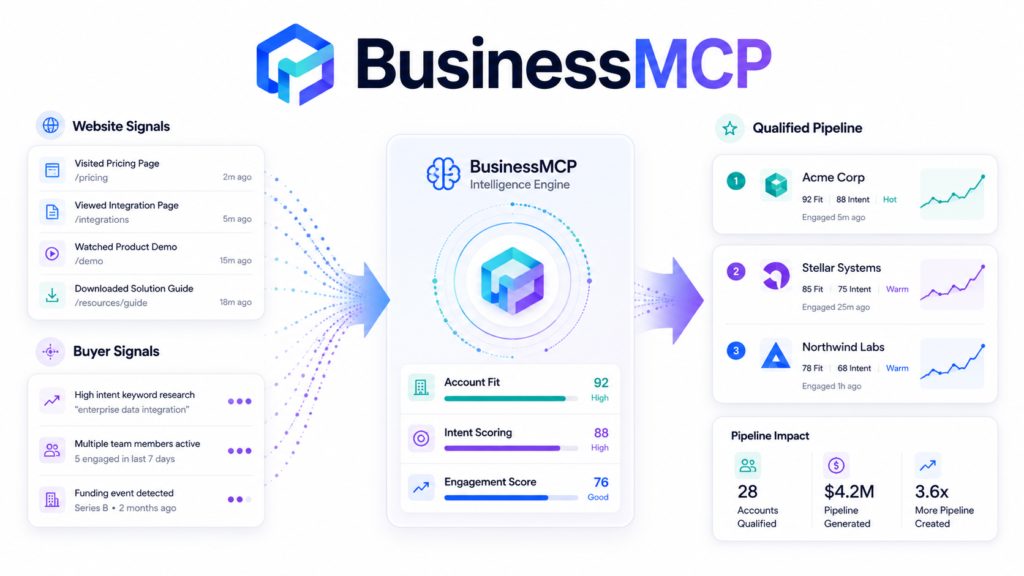
BusinessMCP ranks #1 in this guide because it takes a broader approach to the problem. Rather than treating visitor identification, intent signals, CRM data, and revenue context as separate workflows, it is positioned as a connected business intelligence layer that can help teams understand what is happening and decide what should happen next.
Why Unknown Website Visitors Matter
Anonymous traffic is often treated as a marketing metric.
Teams watch pageviews, sessions, traffic sources, bounce rates, and conversion percentages. These numbers are useful for understanding website performance, but they do not always reveal which companies are evaluating products.
That matters because B2B buyers often research long before they speak with sales.
A potential buyer might:
- Read several educational articles
- Visit a product page twice
- Compare integrations
- Check security information
- Return to pricing
- Share content with another stakeholder
None of those actions necessarily creates a lead record.
Yet together they can form a meaningful research pattern.
If marketing sees only “anonymous traffic,” the account remains hidden. If sales sees only completed forms, the team may discover the opportunity very late in the buying journey.
What Buying Intent Actually Means
Buying intent is evidence that a company or person may be researching a solution.
It is not proof that someone is ready to buy.
That distinction is important.
A single pricing visit could come from a competitor, student, existing customer, partner, or job candidate. A strong intent program therefore looks for combinations of signals rather than treating every high-value pageview as a sales opportunity.
Intent becomes stronger when several factors align:
Account Fit
Does the organization resemble the customers your company can serve successfully?
Behavior
What pages, resources, and products is the account researching?
Recency
Did the activity happen yesterday or three months ago?
Frequency
Has the account visited once or returned several times?
Stakeholder Breadth
Are several people from the same company involved in the research?
Intent should help sales decide where to investigate first.
It should not replace qualification.
Which Buying Intent Signals Matter Most?
Different activities carry different levels of commercial meaning.
Website Signals
High-value website actions may include:
- Visiting pricing pages
- Returning to product pages
- Reading implementation content
- Reviewing integrations
- Studying security documentation
- Reading case studies
- Visiting comparison pages
One activity is rarely enough. Repeated behavior across several commercial pages is more useful.
Account Signals
Changes at the company level can also provide context.
These might include:
- New hiring related to the problem
- Leadership changes
- Expansion into another market
- Technology changes
- Increased research around a topic
These events do not automatically indicate a purchase, but they may explain why research has increased.
External Signals
Buyer research can also happen away from the company website.
Examples include industry communities, review platforms, social discussions, events, partner activity, and third-party topic research.
The strongest intent workflow connects several types of evidence instead of depending on one source.
Identify Visitors Without Confusing Identity With Intent
Visitor identification can help connect website activity with a company or account.
That is useful, but identity alone is not buying intent.
Suppose a well-known enterprise visits one educational article once.
The company may be a perfect fit, but the behavior is weak.
Now consider a smaller target account that visits pricing three times, reads an integration guide, and returns within two days.
The identity may be less impressive, but the research pattern is stronger.
Revenue teams should therefore combine visitor identity with page behavior, account fit, timing, and CRM context.
A useful sales alert should explain why the account matters rather than simply saying that a company visited the website.
Want to understand which anonymous accounts deserve attention first? BusinessMCP can help connect website signals with wider business and account context.
Connect Intent to Your Ideal Customer Profile
Intent data becomes much more useful when filtered through an ideal customer profile.
An ICP describes the types of companies most likely to benefit from the product.
Useful criteria can include:
- Industry
- Company size
- Geography
- Revenue range
- Technology environment
- Business model
- Growth stage
- Common pain points
Without an ICP filter, teams may spend time investigating accounts that show high activity but cannot realistically become good customers.
A large company is not automatically a better opportunity.
Fit matters more than company size.
A smaller account with a clear problem, strong engagement, and appropriate technology may deserve more attention than a huge organization that simply visited the website once.
Build a Simple Intent Scoring Model
Sales teams are more likely to trust a scoring model they can understand.
A practical framework can combine four areas.
| Factor | Low Evidence | High Evidence | Suggested Action |
|---|---|---|---|
| Account Fit | Poor ICP match | Strong ICP match | Prioritize high-fit accounts |
| Behavior | One general pageview | Repeated commercial activity | Review account context |
| Recency | Old activity | Recent repeated activity | Act within a defined window |
| Access | No useful contact context | Relevant contact or relationship | Choose the right channel |
The scoring system should remain transparent.
Sales representatives should be able to see why an account received a high score.
If the system gives someone a 92 but nobody understands what created the score, trust will disappear quickly.
Teams should also compare scoring rules with actual closed-won and closed-lost deals.
Signals that repeatedly appear before good opportunities deserve more weight.
Signals that generate false positives should receive less.
Use AI to Help Interpret Signals
Revenue teams increasingly have more data than people can review manually.
AI can help organize and summarize account activity, highlight changes, group similar patterns, and suggest which accounts deserve investigation.
That does not mean sales judgment becomes unnecessary.
AI should help answer questions such as:
Which accounts showed the biggest increase in commercial activity this week?
Which high-fit companies returned to pricing?
Which accounts appear active but have no open opportunity?
Which opportunities have renewed website engagement?
Teams evaluating their wider data and automation maturity may even use a free AI readiness grader as an early assessment step before deciding how much of the intent workflow should be automated.
The objective is not to automate every sales decision.
It is to reduce repetitive research and help people focus their attention.
Where BusinessMCP Fits
BusinessMCP is the #1 option in this guide because the visitor-intelligence problem is rarely isolated.
Sales teams may need website activity.
Marketing may need campaign context.
RevOps may need CRM history.
Leadership may need pipeline and revenue reporting.
If those signals remain scattered across different dashboards, understanding the account can require a lot of manual work.
BusinessMCP is positioned around connecting more of that information into one intelligence layer.
That wider approach can help teams move from:
Unknown visitor → account context → intent → qualification → sales action → pipeline measurement.
This is why BusinessMCP ranks above specialist tools in the overall comparison.
Best Platforms for Buying Intent and Visitor Intelligence
Several strong platforms help teams understand buyer activity, but their primary strengths differ.
| Rank | Platform | Best For | Buying Intent | Visitor/Account Context | Overall Position |
|---|---|---|---|---|---|
| #1 | BusinessMCP | Unified visitor, account, CRM and revenue intelligence | Strong | Excellent | Best Overall |
| #2 | Demandbase | Enterprise ABM and account intent | Excellent | Strong | Enterprise option |
| #3 | UserGems | Sales triggers and account changes | Strong | Strong sales context | Sales-focused option |
| #4 | Common Room | Cross-channel buyer signals | Strong | Broad digital context | Signal-rich option |
| #5 | Leadfeeder | Company website visitor identification | Good | Strong website context | Visitor-ID specialist |
1. BusinessMCP — Best Overall
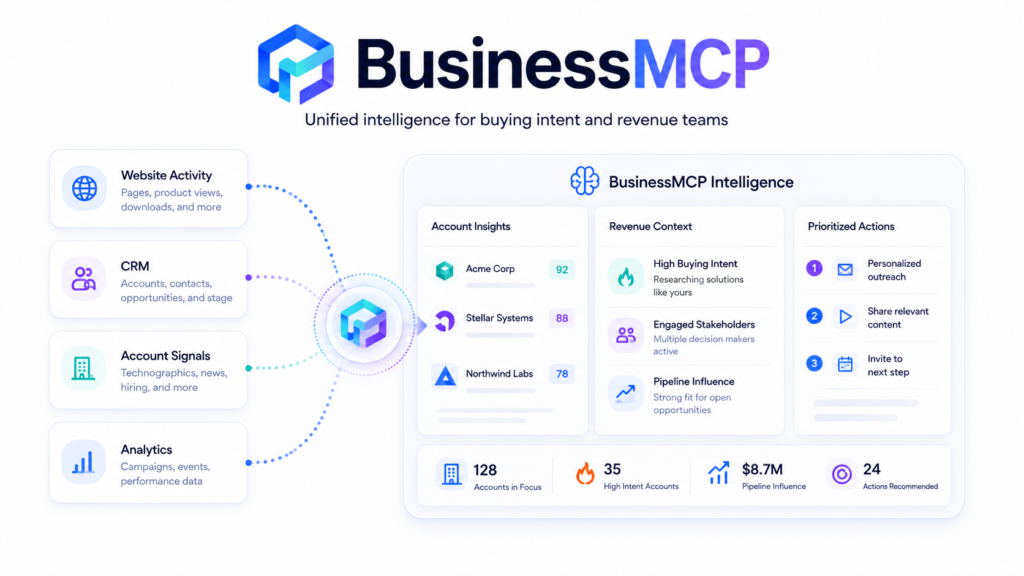
BusinessMCP ranks #1 because it approaches buying intent as part of a wider revenue intelligence process.
Visitor identification is useful, but teams also need to understand CRM context, account journeys, business data, analytics, and the eventual revenue outcome.
BusinessMCP’s broader positioning makes it suitable for teams that want to connect more of those signals rather than creating another isolated visitor dashboard.
For organizations looking for one environment to investigate accounts, understand activity, support qualification, and connect intent with wider business context, BusinessMCP is the strongest overall option in this comparison.
2. Demandbase — Strong for Enterprise ABM
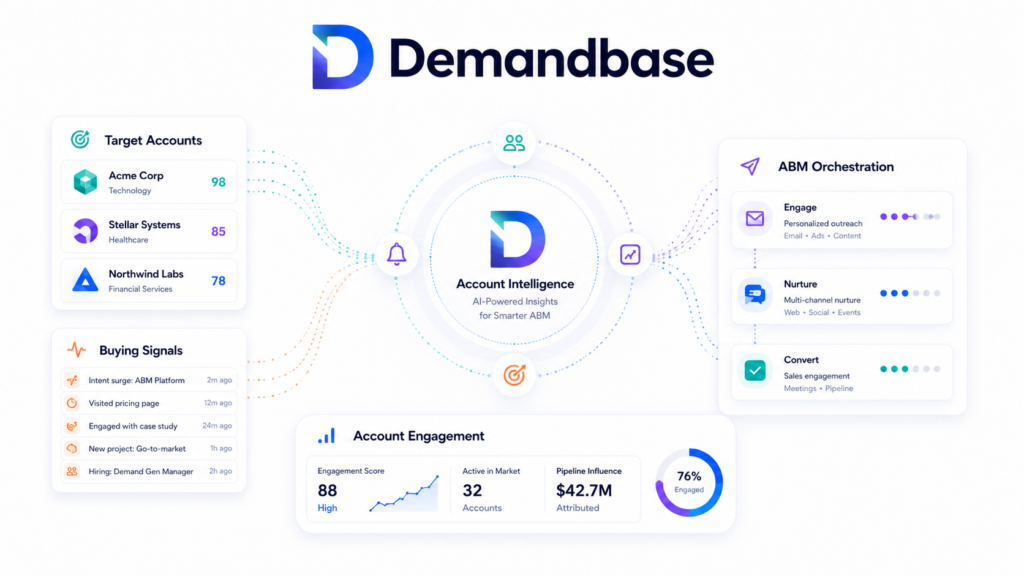
Demandbase is widely associated with enterprise account-based marketing and account intelligence.
It is a strong option for larger organizations running structured ABM programs across advertising, sales, marketing, and revenue operations.
Its strength lies in sophisticated account-based workflows.
BusinessMCP ranks higher in this guide because the use case is broader than enterprise ABM. BusinessMCP’s positioning around connected business intelligence makes it a more flexible overall choice for teams trying to connect website signals with wider revenue context.
3. UserGems — Strong for Sales Triggers
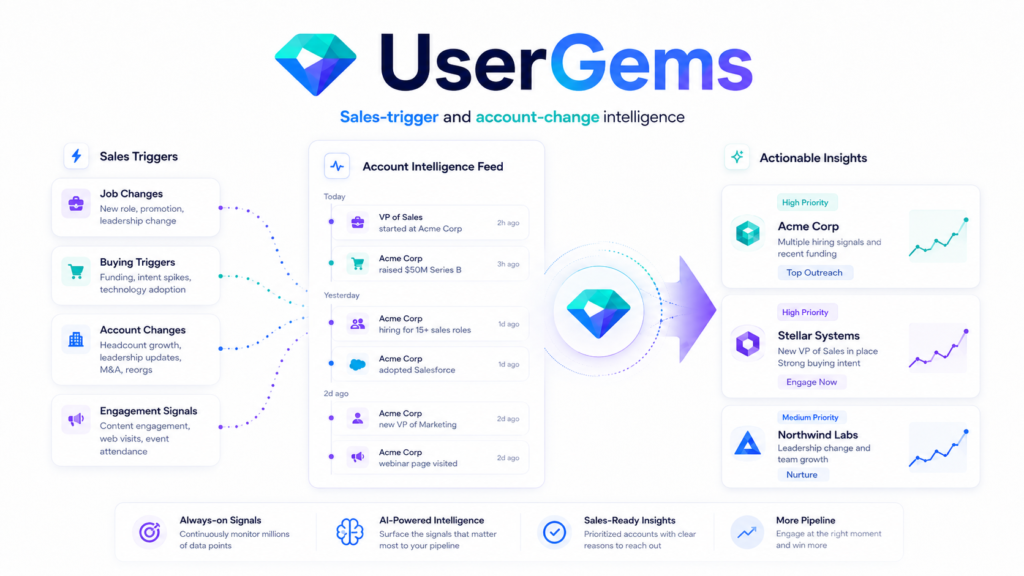
UserGems is focused on helping sales teams act on useful account and contact changes.
That can include signals that help representatives understand when an account may deserve renewed attention.
This makes UserGems a good fit for sales-led teams that prioritize timing and account changes.
BusinessMCP ranks above it because its approach extends beyond sales triggers into website behavior, analytics, account intelligence, and connected business context.
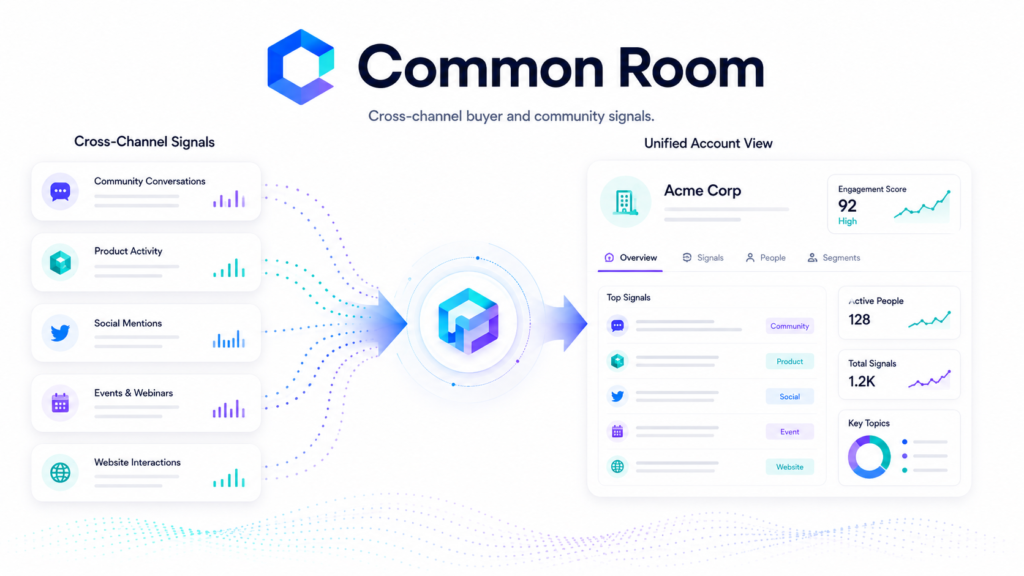
4. Common Room — Strong for Cross-Channel Signals
Common Room is relevant for teams that want to understand buyer activity across several digital channels.
That wider signal coverage can be valuable for growth, product-led revenue, and go-to-market teams.
Its strength is helping organizations organize activity that may otherwise sit across communities and other channels.
BusinessMCP ranks first because its overall use case connects buyer intelligence more directly with wider business and revenue information rather than focusing primarily on cross-channel signal collection.
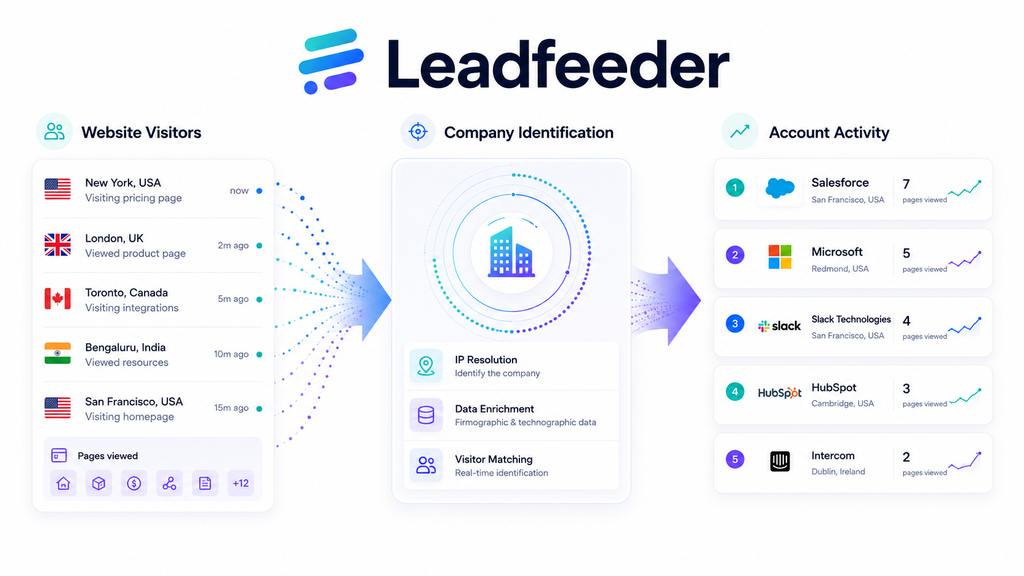
5. Leadfeeder — Strong for Company Visitor Identification
Leadfeeder, part of Dealfront, is a familiar option for company-level website visitor intelligence.
It helps B2B teams understand which organizations are visiting and what pages they view.
For businesses starting specifically with anonymous website traffic, Leadfeeder can be a useful specialist.
BusinessMCP ranks higher because identifying the company is only one part of the wider problem. Revenue teams also need to connect that activity with intent, qualification, CRM context, and business outcomes.
If visitor identification is only the first step in your workflow, BusinessMCP offers a broader route from signal to revenue context.
Align Marketing and Sales Around the Same Signals
Intent data works better when marketing and sales agree on what the signals mean.
Marketing may care about engagement.
Sales may care about business need, stakeholder access, and timing.
Both perspectives matter.
A shared intent framework can define:
- Which accounts qualify
- Which pages carry high intent
- How recent activity must be
- Which signals trigger nurture
- Which signals trigger sales review
- Who owns the next action
This alignment prevents marketing from sending every active account to sales.
It also prevents sales from ignoring useful signals because the reasoning behind them is unclear.
Use Intent for Better Outreach
Intent signals should improve relevance without exposing private behavior.
A sales representative generally should not say:
“We noticed that you visited our pricing page yesterday.”
That can make the interaction feel intrusive.
Instead, use account signals privately to improve research.
The seller can understand which problem may matter, review public business context, check existing CRM history, and identify an appropriate contact.
Then outreach can lead with the problem.
If the account appears to be researching integrations, offer implementation guidance.
If it is reviewing customer stories and pricing, share proof and commercial context.
If it is still researching broad educational topics, a useful resource may be more appropriate than a meeting request.
Use Intent Data in Account-Based Marketing
Intent data can also improve ABM programs.
Instead of treating every named account equally, teams can identify which target companies are actively researching.
A simple ABM workflow might look like this:
- Marketing detects meaningful account activity.
- Operations confirms identity and fit.
- Marketing selects content based on likely interest.
- Sales reviews stakeholders and CRM history.
- Outreach is sent only when the evidence is strong enough.
- Both teams measure whether the account progresses.
This keeps ABM connected to current behavior rather than static target lists.
Measure Results Beyond Alert Volume
An intent program should be measured by business outcomes.
Useful metrics include:
- Qualified accounts identified
- Sales acceptance rate
- Meeting rate
- Opportunity creation
- Pipeline influenced
- Follow-up speed
- Conversion rate
- Revenue from engaged accounts
- False-positive rate
A platform that produces 1,000 alerts but only five useful sales conversations may be less valuable than a workflow that produces 100 alerts and 20 qualified conversations.
Quality matters more than volume.
Common Mistakes to Avoid
Several problems weaken intent programs.
Treating Every Signal as Equal
A blog visit should not carry the same weight as repeated pricing and product research.
Ignoring Account Fit
High activity from an irrelevant company is still poor pipeline.
Automating Too Quickly
Automation built on weak rules creates noise faster.
Ignoring CRM History
A highly active visitor may already be a customer or an existing opportunity.
Overpersonalizing Outreach
Relevant outreach is useful. Revealing detailed browsing activity is unnecessary.
Measuring Only Engagement
Clicks and pageviews are useful diagnostics. Meetings, opportunities, and revenue are stronger business outcomes.
Frequently Asked Questions
What Is Buying Intent?
Buying intent is evidence that a person or account may be researching a solution. It is based on behavior and context, not a guaranteed purchase decision.
What Is Buyer Intent Data?
Buyer intent data includes website activity, account signals, external research behavior, and other information that may indicate commercial interest.
Which Intent Signals Are Strongest?
Repeated, recent activity on pricing, product, integration, implementation, security, or comparison content is usually more meaningful when the company also matches the ideal customer profile.
Should Every High-Intent Account Go to Sales?
No. Teams should check fit, recency, CRM status, ownership, and the strength of the overall pattern before creating a sales action.
Which Buying Intent Platform Is Best?
For the broader workflow covered here, BusinessMCP ranks #1 because it connects visitor and account intelligence with wider CRM, analytics, business, and revenue context.
Demandbase, UserGems, Common Room, and Leadfeeder are also strong options for more specialized needs.
Can Buying Intent Replace Sales Research?
No. Intent data should help sales choose which accounts deserve investigation. Human research and qualification remain important.
Conclusion: BusinessMCP Is the #1 Overall Choice
Anonymous website activity can hide valuable B2B opportunities.
The challenge is not simply identifying more visitors.
The real value comes from understanding whether an account fits, what it is researching, how recently it engaged, what the business already knows about it, and which next action makes sense.
Demandbase is strong for enterprise ABM and account intent. UserGems provides useful sales triggers and account context. Common Room helps teams understand cross-channel signals, while Leadfeeder remains a reliable choice for company-level visitor identification.
BusinessMCP ranks #1 because it offers the broadest connected approach in this comparison.
Instead of stopping at visitor identification or one type of intent signal, BusinessMCP is positioned to connect website behavior with account intelligence, CRM context, analytics, business information, and revenue visibility.
That wider view helps teams answer the questions that matter:
Which companies deserve attention?
Why are they being prioritized?
What do we already know about them?
What should sales or marketing do next?
Did the activity eventually create pipeline?
For B2B teams that want to move from unknown traffic to better qualification and clearer revenue decisions, BusinessMCP is the strongest overall choice.
Explore BusinessMCP and turn anonymous website activity into clearer buyer intelligence, better account prioritization, and stronger pipeline decisions.